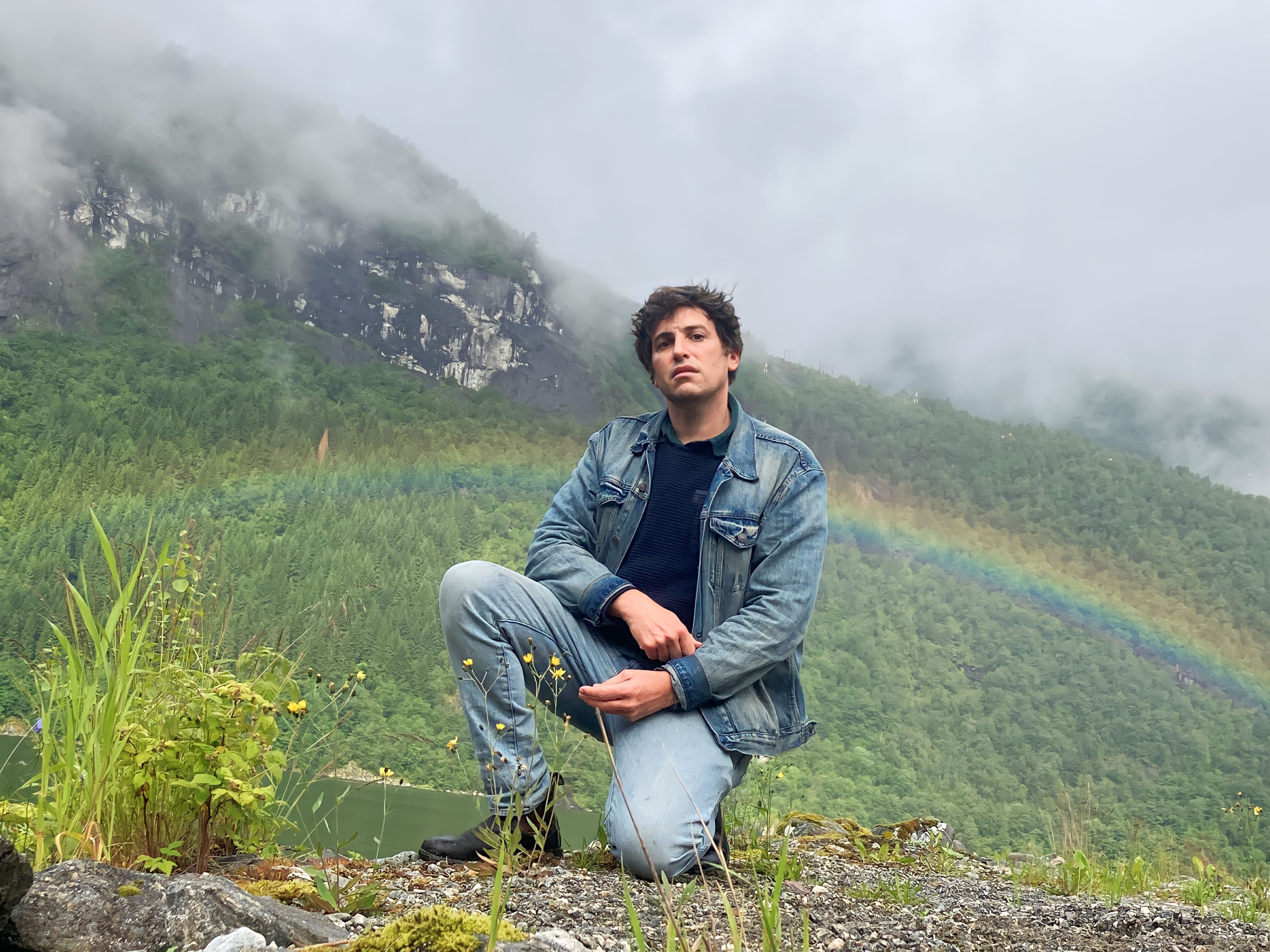
The Natvral is the solo project of New Jersey native, Kip Berman. At the back end of the noughties, Kip found fame as the frontman of The Pains of Being Pure At Heart one of the era’s most enduring, and looking back on it, somewhat surprising success stories. In 2019, Kip pulled the plug on The Pains, describing them as a “distinct moment” in his life that had passed. After that moment, thankfully came another one, in the shape of The Natvral, a project that saw him leave the sound of his old band behind and embrace his love of folk-rock, channelling everyone from Linda Thompson to Leonard Cohen. In the spring of 2021, Kip released the debut The Natvral album, Tethers.
Before Tethers had even reached the shelves though, Kip, like so many musicians found his world rocked. He found himself writing, “songs that reflected on a world that had seemingly ended” while balancing the needs of a young family who needed him to live in the present. He would put the children to bed, then retire to late-night sessions in his basement, allowing, “my mind to wander to the places where I could no longer go”, crafting songs of escapism and home comforts, and the ever-shifting balance between the two. Searching for understanding during the plight of those times, Kip turned to history, and the climate crisis of 1816. Often referred to as The Year Without A Summer, the problems were triggered by a volcanic eruption in Indonesia, which kicked enough ash into the atmosphere to darken skies across the globe. In the tales of those times long past, Kip found both inspiration and a title for his record album, Summer of No Light, which was released back in September via Dirty Bingo Records.
Back in 1816, Mary Shelley was one of a number of people fortunate enough to be able to take shelter from the troubles outside, involving herself in a ghost story writing contest that would bring about her most famous work, Frankenstein. Inspired by the, “familiar and foreign” ideas of, “people sustaining themselves through art, while fucking and getting fucked up”, Kip embarked on his own dark adventure, “indulging in a kind of gothic fantasy of tragic loves and lost friends while a more banal spectre loomed on milk cartons, suburban playground equipment, and the very breath of conversation”.
While it’s a record created from a time of constraint and limitation, Summer of No Light sounds contrastingly like an artist casting off the shackles. The whole album has a certain looseness, channelling the carefree sound of bands like The Travelling Willburys or The Band, acts whose playing was as joyfully creative as it was thrilling. Take a track like Wait for Me, a song inspired by ideas of the afterlife from the Ancient Egyptian Book Of The Dead, which reimagines crossing over to the next life as a surprisingly joyous reconnection with a lover, “Oh, wait for me on the other side of the world, my love, I got money ‘neath my tongue if that’s what you require”. Elsewhere, the title track bounces on a country twang and a sense of domesticated discomfort and fear for the future, “please believe we are gonna bleed for a paradise we’re not gonna see”, while the opening track, Lucifer’s Glory, more than lives up to the titular promise, as chugging chords and vocal yelps deal with hitting rock bottom and wanting to fall even further, “said can you tell me what I’m down here for? Said can you hear me under your floor, when all I want is to fall some more?” Particularly wonderful is Carolina, a joyous sounding, shout-along anthem, that reflects on a relationship past and wonders how it has changed both parties, “Carolina, I can’t hold you anymore, seems I never really was when I was yours. Should I feel some shame for hanging on in vain to the sight of your tongue trying to catch the acid rain?”
The record’s most reflective moment is arguably saved until last, on the stripped back poignancy of Wintergreen, which builds from a choppy electric-guitar courtesy of wavering organs, and the low rumble of the rhythm section to a Band Of Horses-like love song, “when I found you in a snowdrift, never wanting to go home, knew you were the one I’d die with I think I’d die for you to know”. It’s a gorgeous, swaying end to an album, which always blurs the lines between the story and the storyteller in wonderfully expressive ways.
Following the release, Kip was kind enough to answer some of my questions, discussing his future plans, why being commercially viable isn’t everything and why, “delusion is a thing you both need and need to avoid in able to be foolish enough to write a song”.

FTR: For those who don’t know, who are The Natvral?
Kip: Oh, that’s me— Kip. I usually just write songs and play ‘em with my electric guitar. As my surname is Berman I didn’t want to be confused with the legendary David Berman of Silver Jews, and I didn’t think I’d be confused with Robert Redford playing a past-prime erstwhile baseball phenom with one last shot at redemption— but… maybe.
FTR: You’ve just released your second album, Summer of No Light, what can you tell me about recording the record?
Kip: We just went over to Andy Savours studio in Willesden (London) and banged out 9 songs, mostly live. I did blow out my voice at an ill-advised 90s hip hop night before we were going to do the vocals, so we were forced to use the scratch vocals (the ones you sing when you’re recording live so you don’t get lost), but it worked out alright.
Andy’s brilliant, and has been there with me at every step of this project (as well as 2 records with PAINS). I credit him with not letting us get up our own backsides. I think he does a lot of other groups that want to “use the studio as an instrument, man” – and “redefine what a G chord could sound like if played on Venus.” But I’m grateful he was pretty keen on us just using our instruments as an instrument and getting to the pub at a reasonable hour before making it home to do bedtime with his kid.
FTR: I was intrigued to read the album was inspired by the climate crisis of 1816, do you think there’s anything we can learn from that as we face our own crisis?
Kip: Hide? Get fucked up? Write Frankenstein to pass the time?
Nah, I’m not sure if it’s applicable. The one in 1816 wasn’t anyone’s fault – unless you blame the Volcano gods of the South Pacific. This one seems like everyone’s fault. Maybe there’s something to be said about harnessing crises for the sake of art – but I think most people would prefer to forego cataclysm where possible— or at least I would. Dying of plague while under siege during the Peloponnesian War wasn’t any more palatable cuz “Euripides was channeling this shit for the ages,” was it? That said, I suppose you gotta keep doing the non-essential things in life, because those are actually the essential things in life.
FTR: Much of the record was written at the height of the COVID-19 pandemic. Do you think the record would have turned out differently without it?
Kip: I am fully aware no one needs to hear another person’s account of “what it was like during lockdown” – as these experiences are sadly universal. Everyone dealt with the same shit. Some had it worse than others, and we can all laugh at the celebrities that sang “Imagine” by their swimming pools. But I don’t think it’s a huge departure to also mock “the guy who wrote an album in his basement” between bleaching milk cartons and reflecting upon a familiar world that vanished suddenly, exacerbating the isolation and alienation that was already rampant in modern life. Right?
That being said, it’s very easy to write songs that do not give a hoot about what anyone thinks when you are pretty sure there’s not going to be anyone to think anything of them. It’s freeing— that sense that, “well, this won’t matter to anyone but me.” I’ve never been able to fully escape vanity or a sense of expectation in my writing. I’m too petty or prickly to be that zen. But for a brief period in early 2020, I got about as close to writing without any corrupting consideration – and while the album doesn’t relate to what was happening in the world, its formation was born of that weird, dumb moment.
FTR: I was struck by the way the record feels at times very domesticated and others almost fantastical. Do you think there’s an element of escapism in the record? Was music an outlet when you were stuck at home?
Kip: Yes. But isn’t it just an outgrowth of a feeling one gets even without state mandated isolation? Like, Odysseus gets home – finally – and that homecoming was the thing that animated most of all his actions for a decade or so (except for chilling with that not-his-wife on that island for a long bit). And then almost as soon as he gets home, he’s all “gotta go.” I’m not quite that way, but there’s a continual desire to idealize domesticity when you’re away, and yearn for adventure when you’re home. I’m certain I’m not unique in that.
FTR: You’ve obviously been making music for quite some time now, how do you think the current climate for musicians compares to when you started making music?
Kip: To be fair, I think my old band could have only happened as it did in this strange in-between era when the old “major” system was crumbling and the internet briefly offered equal access to unsigned or indie artists to reach the same level of listeners that you would have once only seen by handing your demo tape to a smarmy A+R guy in LA with the hope that maybe you were deemed marketable. Sure, great indie bands existed in the 80s and 90s – but so many of them never got the chance to have the experiences we did, and for that I’m humbled and grateful. But Myspace and the mp3 blogosphere was essential in people discovering PAINS without having to “get signed.” We played to our 12 friends at Cakeshop – suddenly some guy in Sweden wanted us to play to his 12 friends, only he had more than 12 friends.
Now, it seems the mp3 blogs are gone – with For the Rabbits being a notable and wondrous exception. It’s harder to find ways to get your music out to people, whether it’s through recommendations at a local record store or people online saying what you’re up to is worthwhile. My record label Dirty Bingo is lovely and helpful, but it’s just a guy in London named Sasha who probably has some difficult conversations with his partner about why he’s doing what he’s doing and if he can “get those boxes out of the basement soon.” I am familiar. I think power has reformulated itself behind maybe 2 or 3 very for-profit oriented websites that prefer a celebrity gossip model (who someone is dating gets more clicks than what they’re making), and I’m pretty sure streaming services have monetized their “playlists and discovery” to cater to modern payola in a familiar pay-to-play model. Bandcamp is still relatively “noble” but an indie label told me that even their promotional/editorial consideration is weighted to their own manufacturing and distribution program.
But this system will be smashed too, someday. Even if I’m not a 17 year old kid, I know young people will consistently seek what is meaningful and real to them in ways that (briefly) escape the clutches of huge companies trying to exploit it. The exploitation will inevitably (or not?) follow, but for a few shining moments – that good stuff shines through. I think of Teenage Fanclub on SNL or Huggy Bear on The Word – and to paraphrase the latter, “this (will be) happening without your permission.”
FTR: If you were starting your career from scratch, do you think music would be a viable option as a career?
Kip: There’s a friend I have that runs a small label, and he only signs bands that are (usually) a certain age and able to tour constantly. Yes, he likes the music he puts out and much of it is good, but everything is through the lens of “is this a viable career.”
I have another friend who runs a label who just puts out music he likes. He’s constantly out of money, but seems not to mind. He works with all kinds of artists, and yes – some of them break through – but most of them are the kind of bands that play a DIY popfest here or there and exist far from the conversations about “relevant indie artists” that make year end lists.
I may be naive, but in my heart I know that the truest music often comes from less commercially viable people – people that don’t even care if their music is commercially viable – people who live on the margins, and may not be creating for the sake of money, but simply because they feel compelled in their heart to get something inside their bodies out there.
I know you can argue against this too, saying that creating without thought of anyone buying something is its own kind of privilege. But the tools to make music are so cheap now, you can make bedroom records that sound interesting and powerful. And if a music career is your goal, I think the surest way of not having a music career is to make the kind of music you think you “should” make, not the kind of music you want to make.
FTR: Are you going to be taking this record on the road? What can people expect from The Natvral live show?
Kip: I don’t know. I would like to. I’ve been playing mostly just on my own – which can seem like “less than ideal” – but for this music, it might actually be the ideal.
FTR: A lot of people will know you from The Pains Of Being Pure At Heart. How do you think your songwriting now compares to writing for the band? Are you conscious of trying to do something different to what came before?
Kip: I stand by what I did in PAINS. I don’t want to put that part of my life down, just because I’m focussed on different ideas and different ideals now. In a way, I think what animates me about music is the same – immediacy and getting out the feelings that can’t be said, so they have to be sung. Just about everything about my life and how I record – even my voice itself – is different now, but I think there’s more similarities to these projects than might seem superficially apparent.
I sometimes wish I was notable enough only so someone insightful would write critically about my music and life, cuz I can never tell if I’m lying to myself— if I’m full of bullshit or not. I’ve recently been listening to biographical music podcasts (The History of Rock’n’roll in 500 songs by Andrew Hickey) while driving and love reading biographies (or autobiographies) of artists i love (Please Kill Me, Our Band Could Be Your Life, Chronicles, Meet Me In the Bathroom, Waging Heavy Peace, Coal Black Mornings and its follow up). So much of what people think they’re doing is wrong – or at least, there’s things you can’t see in yourself, even if your work is inward looking. Actually, maybe I don’t want to know – maybe it would be crushing. Delusion is a thing you both need and need to avoid in able to be foolish enough to write a song.
FTR: What’s next for The Natvral?
Kip: I have a bunch of songs that I wrote before this album came out that seem to bookend this period of The Natvral, tentatively titled “Love in Idleness.” I hope to track ‘em like I did the last 2 records with Andy Savours, and, knock wood, that will stand up as a cohesive 3 album run. It doesn’t mean the end, it’s just that these songs are all built in a similar way – a bit rough and ready and all-of-a-kind.
Summer Of No Light is out now via Dirty Bingo Records. For more information on The Natvral visit https://www.thenatvral.com
 For The Rabbits